Commercial security camera installation in Miami.
Worth exactly what its footage can prove.
Two cameras that cost the same can do completely different jobs. One lets you identify the person standing at a door; the other tells you a vehicle was in the parking area overnight and not much else. EKB Network installs commercial security camera systems across Miami and South Florida around that distinction, and around the cable, the switching and the labelling that decide whether the footage is there on the day somebody goes looking for it.

A technician sitting on a ladder to aim a four camera array mounted on a steel pole above a parking area.
What the footage has to prove
Two different things get called a security camera and they are not the same job. One is meant to identify a person: it sits close to a doorway, low enough to catch a face rather than the top of a hat, and covers a narrow scene. The other is meant to tell you an area was occupied, a vehicle in the parking area at four in the morning, a gate that opened, a dock that was busy. That one can sit high and cover a lot of ground, and it will not give you a face. A camera system disappoints when somebody bought the second kind and expected the first. So the design starts with one sentence per position: what does this camera have to prove, to whom, and how long after the fact. Lens, mounting height and how many cameras it takes all fall out of that sentence. It also flags the hard positions early, the ones facing a sunrise or shooting into a glass entrance, because a scene that reads perfectly at two in the afternoon can be blown out at seven in the morning and a black frame after dark.
Heat, water and lightning get a vote
Inside a building, a camera run is straightforward. The moment the cable leaves the building, South Florida gets a vote. Sun cooks anything with a plastic body and dries out the sealant on a housing that was mounted so water can sit on top of it. Driving rain finds the one fitting that was not tightened. And a strike does not have to hit the pole to matter: surge rides in on the copper from a hit nearby and travels toward whatever is on the other end, which is the switch and the equipment plugged into it. So outdoor work gets a weatherproof enclosure, cable brought in from underneath instead of through the top, gasketed housings, a drip loop where a lead enters anything, and inline surge protection on the low-voltage runs that leave the building. Surge protectors are the cheap part of the bill and they are built to die so the equipment behind them does not. Leaving them out looks identical on handover day and shows up after the first storm season.
Mounted so somebody can reach it in year three
A camera that cannot be serviced is a camera you replace instead of fix. On a pole, banding beats drilling: nothing is bored into the structure, and the cluster can be shifted or added to later without patching holes. Height is a decision, not a default. Put a camera at the very top of a pole and you have bought yourself a lift to clean it or re-aim it; keep it a little lower and a ladder does the job, and the pole stays out of its own picture. Cable leaves the housing in a short run of liquid-tight flexible conduit back into the pathway, so the cable does not sit bare in the sun or hang loose where landscaping equipment will find it. And aim is set up at the camera, by hand, with somebody watching the live view, because a camera pointed from memory is a camera pointed at the property next door.
The camera is the smallest part of a camera system
The camera is the part you can see. Behind it sit the cable, the switch feeding it over PoE, the recorder writing to disk, and the retention setting that decides whether last month still exists when somebody asks for it. That is where camera jobs go sideways: a switch port nobody can identify, a recorder hanging off a guessed uplink, a run that was never tested, a disk that has been overwriting for a week. So ports get a printed label naming what is on the other end of the run, the runs get tested rather than eyeballed, and recording, retention and remote viewing get set up and checked before the job is called done. If the equipment closet is already a knot, the camera work goes faster and costs less once the rack is sorted out first. Our rack cleanup and structured cabling pages show what that looks like finished.
From these jobs
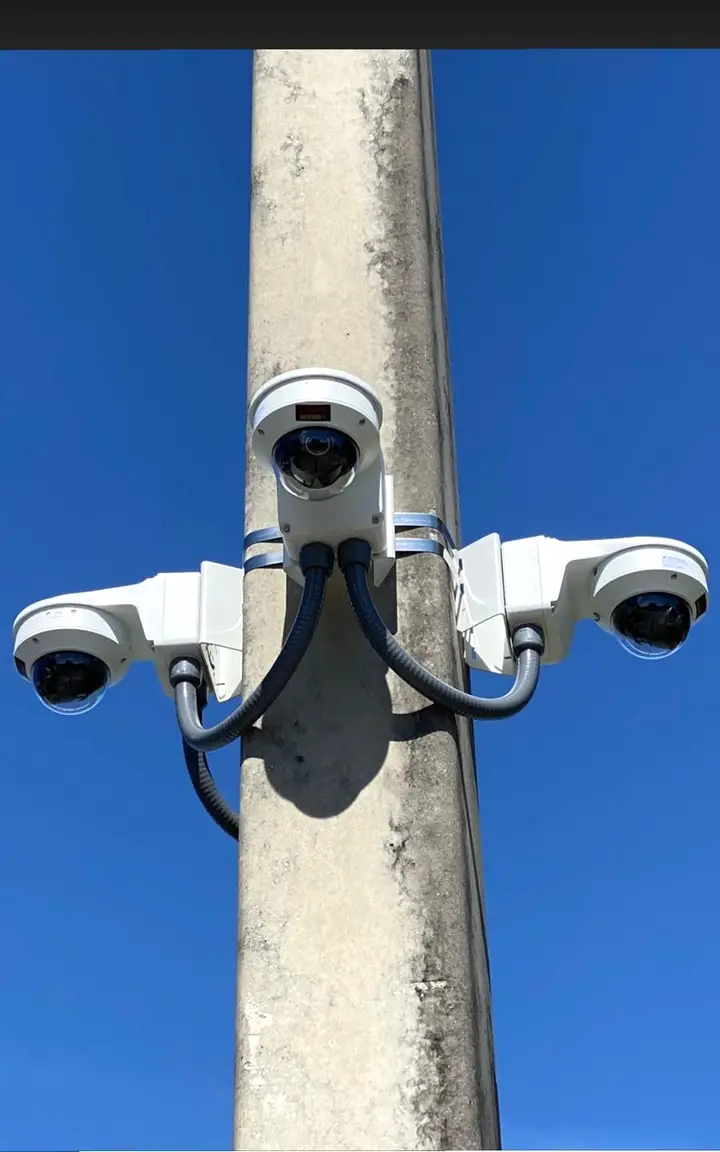
PLATE 01
Three surveillance cameras clamped to a concrete pole and joined by flexible conduit whips, seen from below against a clear sky.
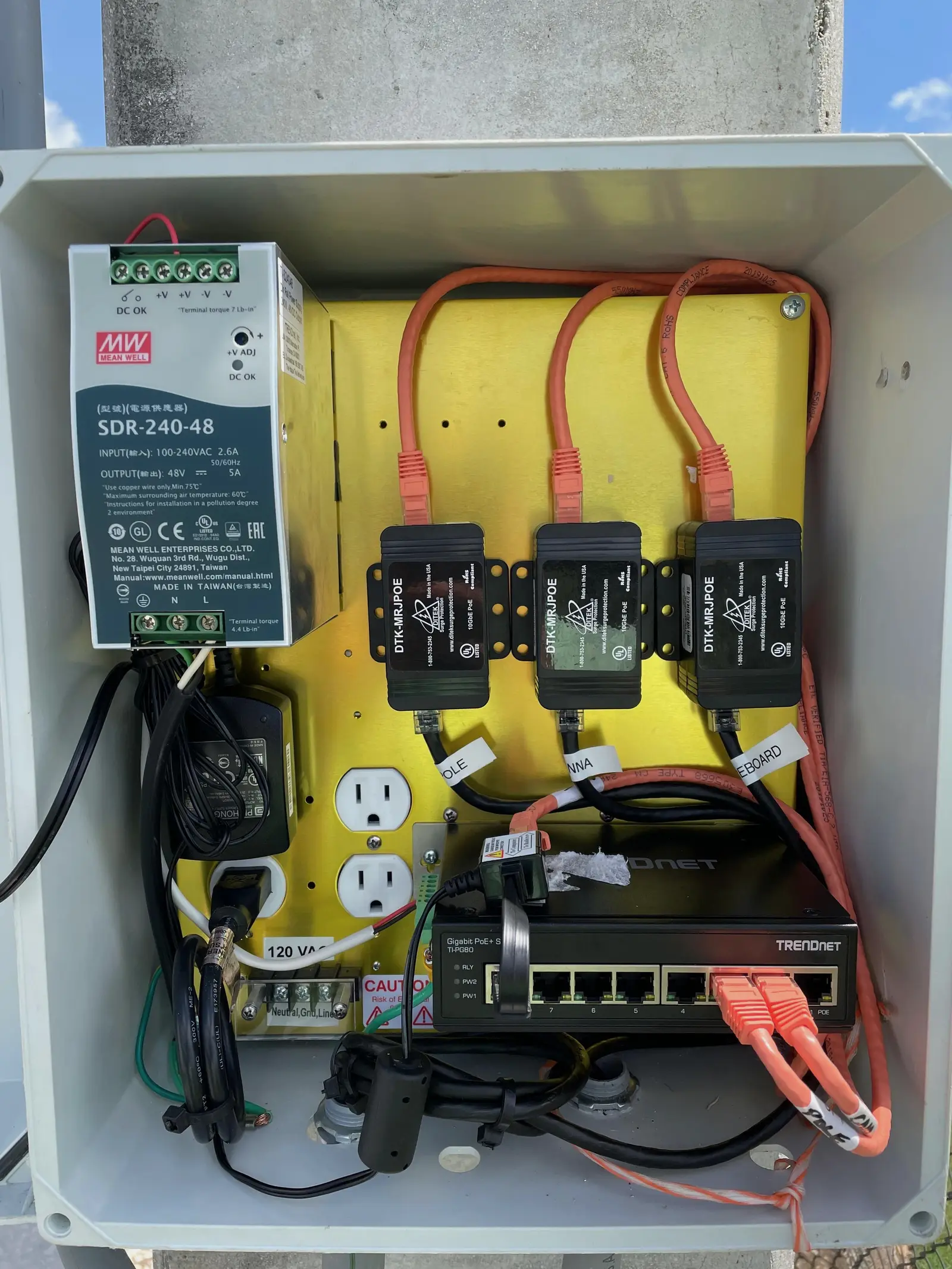
PLATE 02
An outdoor weatherproof enclosure holding a forty eight volt power supply, three surge protectors and a PoE switch, with the ports labelled for a pole, an antenna and a scoreboard.
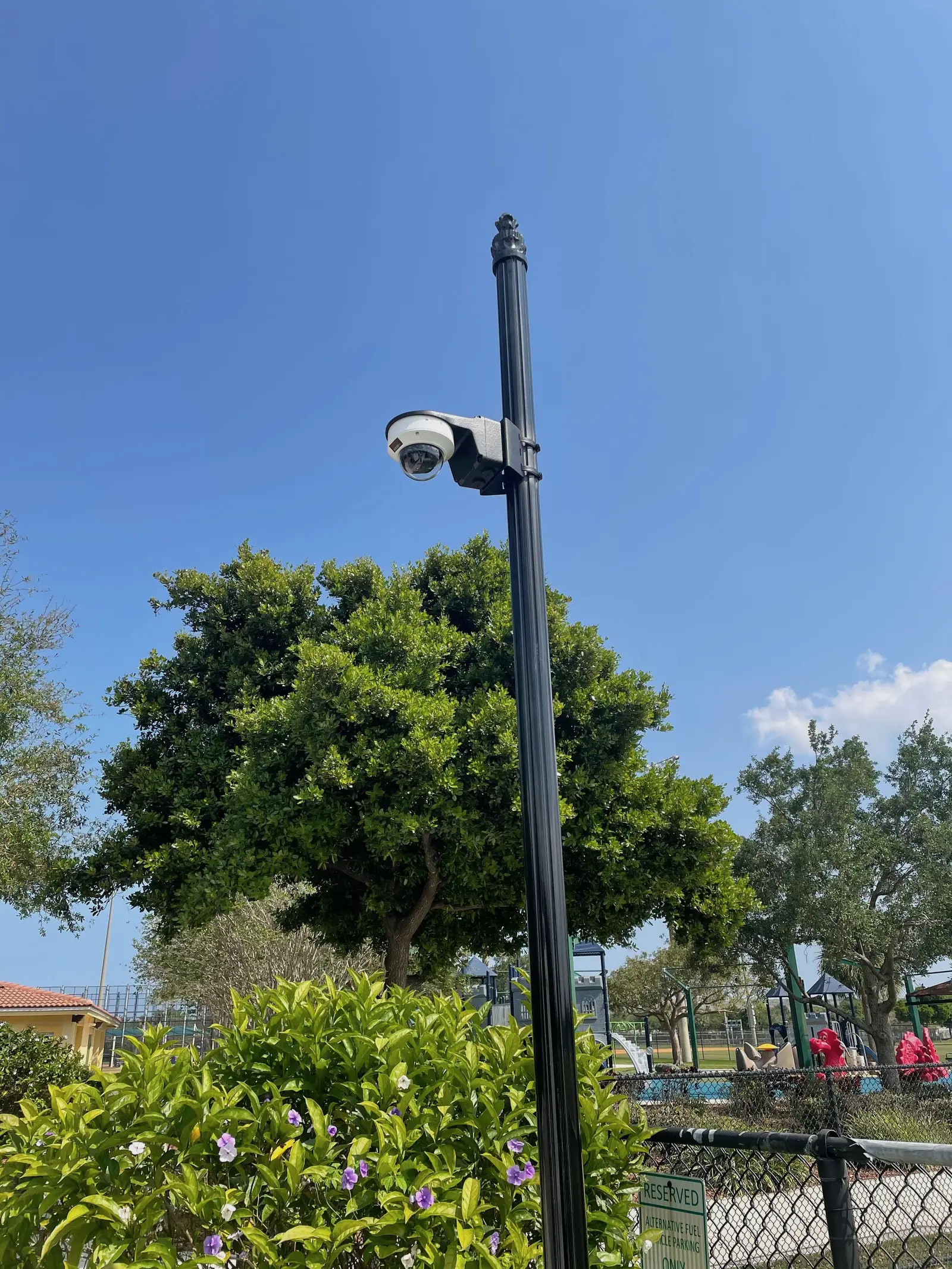
PLATE 03
A surveillance camera mounted partway up a black pole above flowering shrubs, with a playground and shade trees behind it under a clear sky.
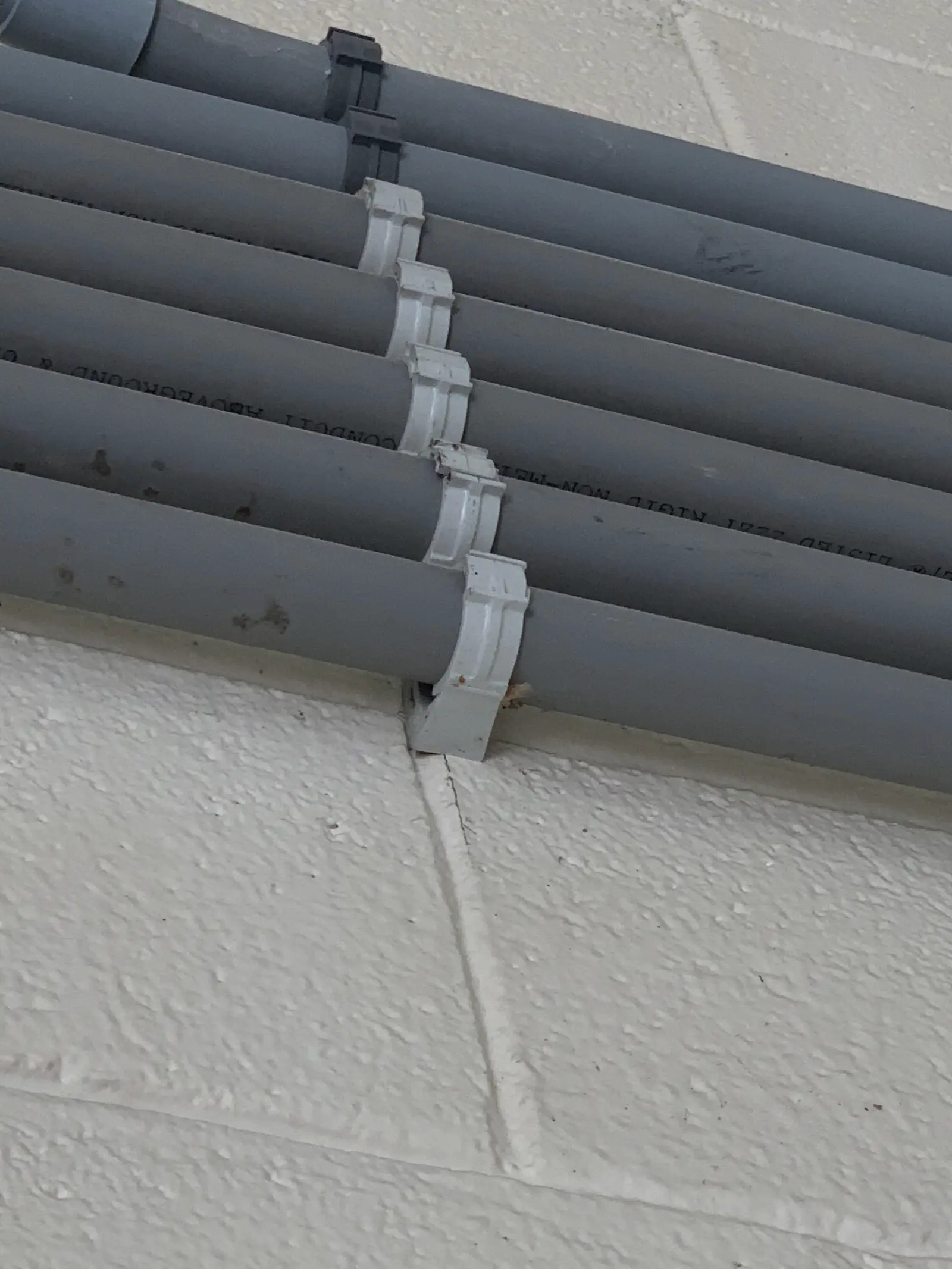
PLATE 04
A bank of grey rigid non metallic conduits running side by side across a painted block wall, each pipe held by its own clamp with the clamps stepping down one after another across the run, and the printed conduit legend still legible along the pipes.


What the work includes
- 01
A walkthrough of the property to settle what each camera position has to prove, before anyone counts cameras
- 02
A cable pathway agreed with whoever owns the ceiling, the walls and the parking area, because pathway is the part that takes the time
- 03
Cable pulled, terminated and tested end to end rather than plugged in and eyeballed
- 04
Pole and wall mounts set square and left within reach of a ladder for service
- 05
Outdoor runs taken into a weatherproof enclosure, with inline surge protection on the lines that leave the building
- 06
Aim and focus set up at the camera with somebody watching the live view, not guessed from the ground
- 07
A printed label on every port, so a fault is traced from the right cable instead of guessed at
- 08
Recording, retention and remote viewing set up and checked on your own phone before the job is called done
Common questions
- How many cameras does a business actually need?
- Fewer than most quotes assume, and the count is an output rather than an input. Write down what you need to be able to prove: who came through the back door, whether a vehicle was in the parking area overnight, what happened at the register at a given minute. Each of those sentences is a camera position, and its purpose sets the lens and the mounting height. A position that only has to show an area was occupied can sit high and wide and cover a lot of ground at once. A position that has to identify a person has to be close, low and narrow, and it covers far less than people expect. Buying by camera count first and working out coverage afterwards is what produces systems with plenty of cameras and no usable footage.
- Will I be able to identify a face, or only see that somebody was there?
- Those are two different jobs needing two different positions, which is why we settle what each camera has to prove before anyone counts cameras. Identifying a person means the camera sits close to where they have to pass, low enough to catch a face rather than the top of a head, and pointed so they walk into it. Watching an area means height, a wider view, and accepting that you get a description and a direction rather than a name. A camera asked to do both at once usually does neither.
- How long is the footage kept?
- As long as the disk will hold, which makes it a decision rather than a fixed number. Retention moves with how many cameras record, at what resolution, and whether they run continuously or on motion. The useful question is how long it normally takes you to find out something happened. If a problem surfaces a week later, a retention window shorter than that is storage you paid for and cannot use. We set it with you and confirm what it actually delivers before the job is called done.
Related services
Tell us about your project.
Send a few details and we will come back with a clear plan and a straight answer.